
How to write a rapid response team policy
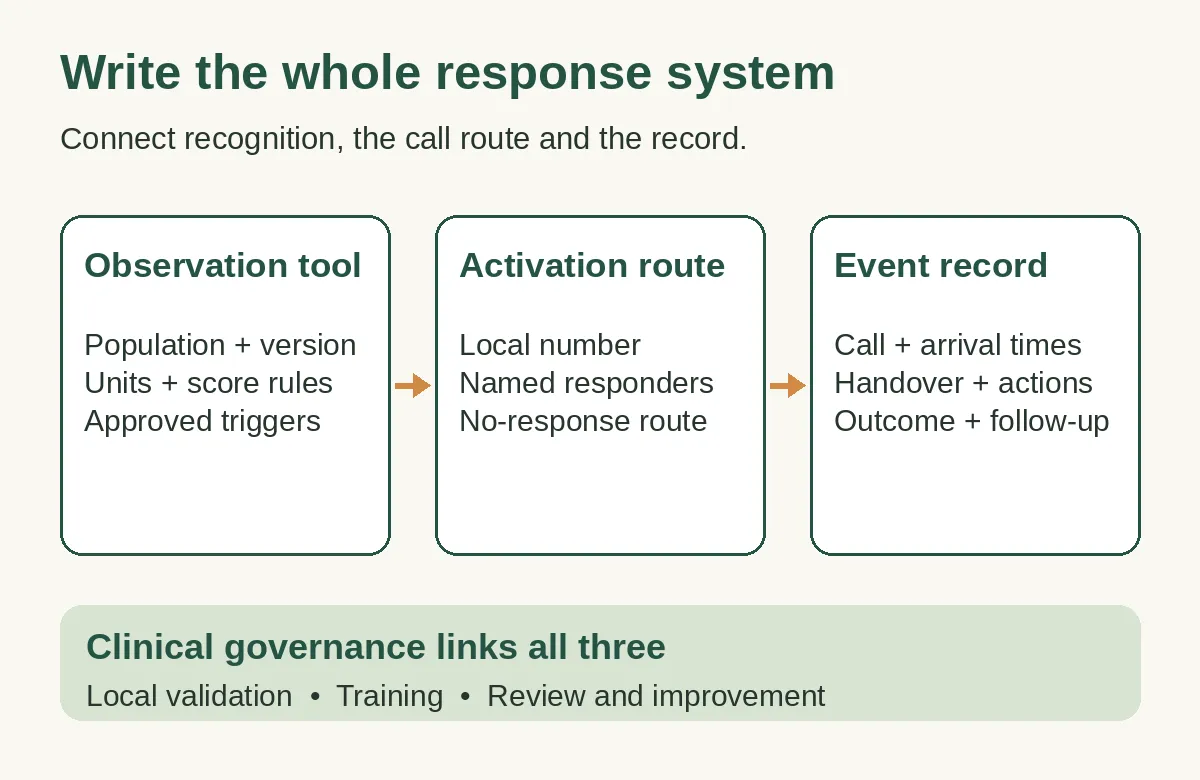
A rapid response team policy should connect recognition of deterioration, the activation route, responder responsibilities and post-event follow-up. Write those connections around a clinically validated observation tool and your facility’s actual staffing. Then check that the policy, score charts, event record and training all describe the same approved process.
Writing your facility’s procedure? Ask us about the Management of Deteriorating Patient (Rapid Response Team) policy while you work through the guidance below.
Policy enquiry
Management of Deteriorating Patient (Rapid Response Team)
Ask us about this policy and the care setting you are writing for. The matching file is not publicly released.
Enquire about this policyDefine who and where the rapid response team policy covers
Start with the population and location, not the team roster. List the age groups, wards and services covered, together with exclusions and the response route for each excluded area. An exclusion from the ward rapid response team must not leave a service without an identified emergency pathway.
Keep adult, pediatric, neonatal and maternity applicability explicit. A familiar early warning score name does not establish that a particular chart is suitable for every population. Record who will approve the tool for each included group.
Write the purpose as a usable outcome: “Enable staff to recognize deterioration, obtain the appropriate response and document handback or transfer.” Avoid promising that a policy will prevent every arrest or guarantee a clinical outcome.
Give clinical decisions and daily operations different owners
A rapid response team is the group designated to respond to calls about deteriorating patients. The wider response system also includes observation tools, callers, communications, training and oversight. Give each part an owner.
| Responsibility | What the policy needs to identify |
|---|---|
| Clinical governance | Who approves the tool, activation rules, clinical protocols and changes |
| Operational lead | Who maintains staffing, contact routes, equipment readiness and training arrangements |
| Calling staff | Who observes, escalates, states the location and prepares the handover |
| Responders | Who leads the event, assesses within their scope and coordinates further help |
| Ward and transfer teams | Who retains responsibility during the event, transfer and handback |
| Review lead | Who checks records, investigates process problems and follows improvement actions |
Name roles and their authorized deputies rather than inserting an old facility’s staff names. Check that a role assigned a task in the procedure also exists in the roster or has a clear on-call route. “Respiratory therapist assists” is incomplete if the facility has not defined how that person is reached out of hours.
The Health Quality & Safety Commission’s April 2021 guidance on leadership and clinical governance, written for New Zealand hospitals, separates clinical oversight from day-to-day operational management. It also allows smaller centers to connect oversight to existing governance structures. Use that distinction to allocate work, while your facility determines its own applicable requirements.
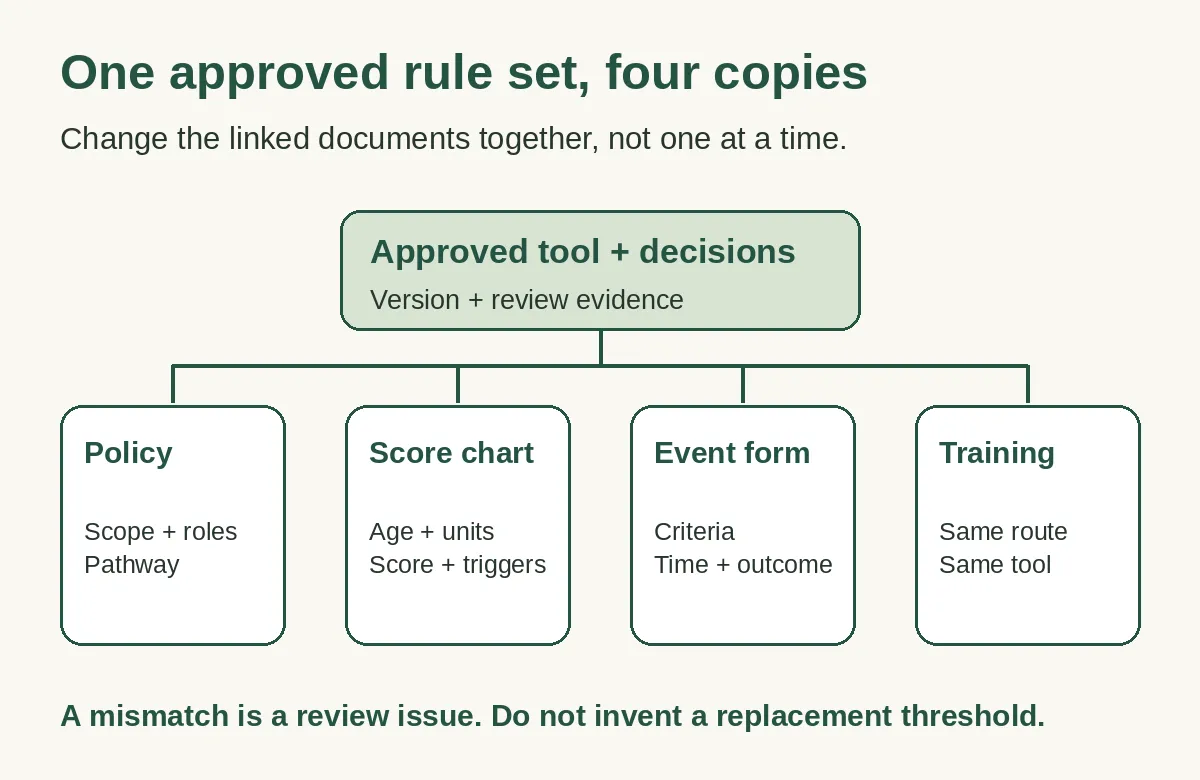
Keep one approved rule set across the attachments
An early warning score combines defined observations into a score linked to an escalation process. Before copying a scoring table, identify its title, issuing body, version, intended population and permission to reproduce or adapt it. Have the relevant clinical leads validate its use locally.
For each tool, record:
- Measurement units, normal limits and any age bands.
- Exactly how scores and clinical-concern triggers lead to escalation.
- Observation and reassessment requirements, including any approved exceptions.
- The linked clinical protocols and who may authorize changes.
- The policy, chart, event form and training versions that use it.
Check boundaries as well as the middle of a range. A value appearing in two columns, an unexplained blank cell or an interval with no score is a review issue. Do not fill the gap from memory or replace a comparator because it looks unusual. Obtain the authoritative tool and record the clinical decision.
The version map below shows why a change must reach every linked copy. An event checklist with a different trigger from the activation guide can create uncertainty at the point of use.
Write the activation route so callers can follow it
Use a procedure table with an action and a responsible role for each step. The calling instructions should state the local number or other approved route, the required announcement, the exact location information and the way the call is acknowledged.
Define what happens if the alert is not acknowledged, a responder is unavailable or further help is needed. Avoid a response-time target with no measurement rule: say when timing starts, what counts as arrival and where those times are recorded. Have operational leaders confirm that staffing and communications support the approved target.
Align rapid response activation with the facility’s resuscitation and emergency policies. The resuscitation lead should approve the distinction between those routes and the instructions that prevent delay. Include the approved route for patient or family concerns, and the relationship to documented goals of care.
Keep treatment instructions in clinically approved protocols with clear professional scope and order authority. A procedure-writing exercise cannot establish safe oxygen targets, fluid rates or medication doses.
Make the event record support handover and review
Arrange the form in the order staff need it: identity and location, reason for activation, observations at the call, responder assessment, actions and orders, outcome, then handback or transfer. Keep the observation units and activation labels consistent with the approved chart.
Record call, arrival and departure times separately. Identify who was notified and when, who led the response, and who accepted ongoing responsibility. Give the narrative enough room to explain the outcome rather than relying on a single “stable” checkbox.
If the form contains medication or investigation checkboxes, state what ticking them means and where the authorized order is recorded. A checklist of actions done or ordered must not become a standing prescription by accident. Pharmacy and clinical reviewers should check the names, routes, units and order-authentication fields.
Define where the completed record is filed, who can access it and which local retention rule applies. Keep clinical records separate from broadly circulated improvement summaries.
Rehearse a night-shift call before release
Use a planned routing drill with the communications team; label it clearly as a drill so it cannot be mistaken for a real emergency. The rehearsal below checks the workflow, not clinical treatment.
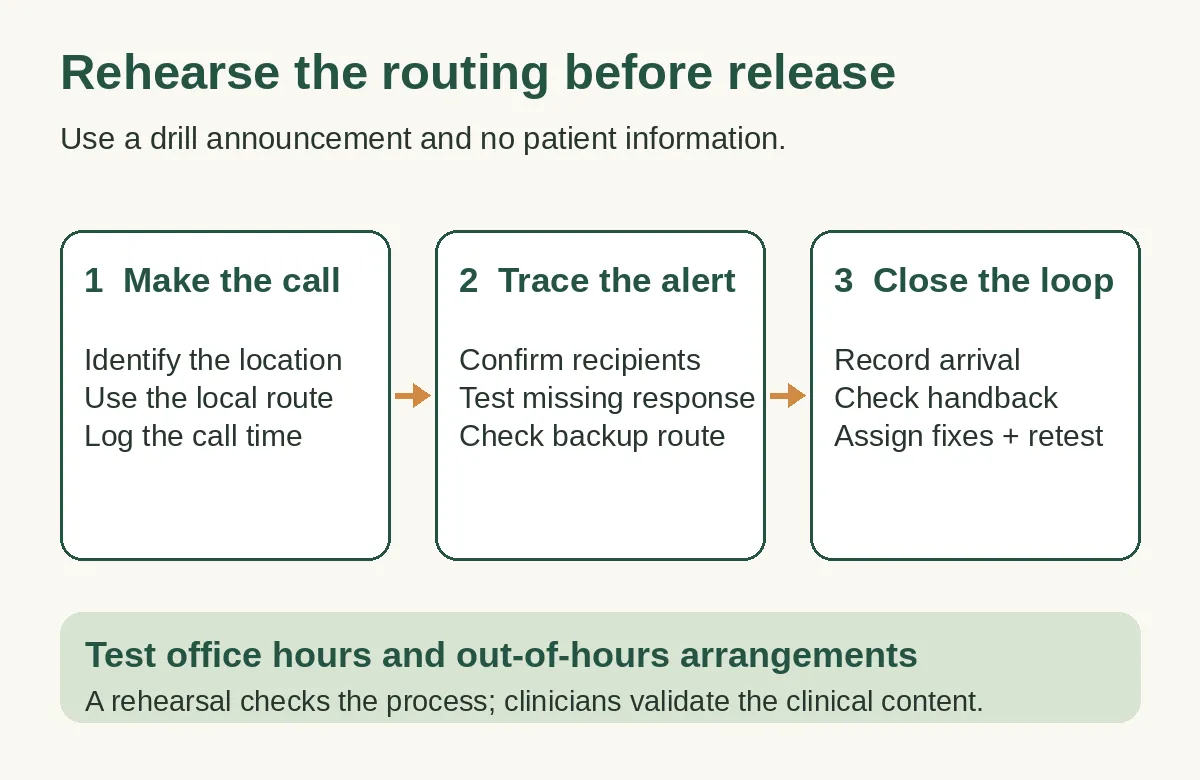
Say a ward nurse uses the approved call route during an out-of-hours drill. The operator receives the ward and room location, but the alert still goes to a former roster holder. The policy’s role description was current; the communications list was not.
Record the mismatch, assign the contact-list correction to the operational lead and repeat the drill. Then test what the caller does when no acknowledgment arrives. A successful first call does not establish that the backup route works.
Also walk through an excluded unit, a transfer with no immediately available receiving bed, and a handback to the ward. Ask participants to show the next step in the policy and record, rather than explain what they normally do from memory.
Close review questions before local approval
Maintain a decision log with the issue, affected section or form, clinical evidence, reviewer, decision and date. Resolve contradictions openly and release the reconciled attachments as one controlled set. Our hospital document control guide explains how approval, effective dates and replacement copies fit together.
Set a review process for missed or delayed escalation, response times, handover problems and unresolved actions. The Commission’s 2021 guidance includes observation-documentation audits, missed or delayed escalation and staff and family experiences among its review topics. Choose measures that your facility can collect consistently and return findings to the teams doing the work.
Before operational use, have the facility’s qualified clinical, nursing, pharmacy, resuscitation and governance leads approve the clinical content and local arrangements. Confirm the roster, call route, chart versions, training and signed document-control fields together.
Questions about your policy topic or file access? Email Policy Writer with your care setting, without patient information or confidential records.