How to write a hospital document control policy
A hospital document control policy should explain who writes, reviews and approves documents, how staff find the current version, and what happens when a document changes or is retired. Give each stage a responsible role and a record that shows it happened. Start with the document lifecycle, then connect the register, approval form, distribution process and archive.
Writing your facility’s procedure? Ask us about the Management and Implementation of Hospital Documents policy while you work through the guidance below.
Policy enquiry
Management and Implementation of Hospital Documents
Ask us about this policy and the care setting you are writing for. The matching file is not publicly released.
Enquire about this policySet the scope of your hospital document control policy
Document control is the process for creating, reviewing, approving, distributing and preserving identifiable versions of an organization’s working documents. In a hospital, that can include policies, procedures, clinical guidelines, protocols, pathways, plans, by-laws, forms and departmental logbooks.
List the document types your facility uses. Separate hospital-wide documents from department-specific ones, but apply controls to both. A departmental procedure should not contradict a hospital-wide policy or create a second instruction for the same work.
Distinguish controlling a blank form from keeping completed records. The form needs an owner and version; completed records need their own access, retention and disposal arrangements. A policy-review interval is not a patient-record retention period.
Write a purpose that names the result: “Staff can identify and use the current authorized instruction, while previous versions remain traceable.” That gives reviewers something to test.
Assign an owner, a controller and an approval route
The document owner writes and maintains the content. Document control manages identification, formatting, the register and authorized distribution. Reviewers check the parts affecting their work. Approvers authorize the final version within their delegated authority.
Use role titles rather than personal names in the procedure. A small facility may combine administrative duties, but it still needs to know which duty a person is performing.
| Role | What the policy should assign |
|---|---|
| Document owner or proponent | Identify need, draft content, coordinate affected teams, resolve comments and supply attachments. |
| Department head | Confirm that responsibilities are workable and arrange staff education in the department. |
| Document controller | Allocate identifiers, maintain the register, prepare final copies, control distribution and preserve history. |
| Subject-matter reviewers | Check accuracy, resources, interfaces with other departments and applicable requirements. |
| Authorized approver | Approve the identified final version and any required implementation conditions. |
Create a signature-authority table by document type and impact. State who recommends, who records concurrence and who gives final approval. A signature labelled “reviewed” should not silently mean permission to implement.
Where a committee has a role, connect its recommendation to the next authority. Our guide to hospital committee terms of reference explains how to separate recommendation from decision authority.
Build a register that identifies the exact version
A document code identifies the document; an edition or version identifies a particular release of it. Keep those meanings separate. Avoid a filename such as policy-final-new-final.pdf becoming the only evidence of version history.
Use a register with these connected fields:
- Code, full title and document type.
- Owner and responsible department.
- Current edition or version, and the version it replaces.
- Approval date, effective date and next review date.
- Status: draft, approved for release, current, superseded or withdrawn.
- Current staff-access location and any controlled paper-copy locations.
- Approval evidence and the archive reference for previous versions.
Match the code, title and version on the document to the register. Put enough identifying information on attachment pages to show which policy and edition they belong to. A revised form should not remain attached to an older procedure by accident.
Decide locally whether retired codes can ever be reused. Whatever the decision, retain enough history to distinguish an old instruction from a later document with the same identifier.
Write the creation and review procedure as handoffs
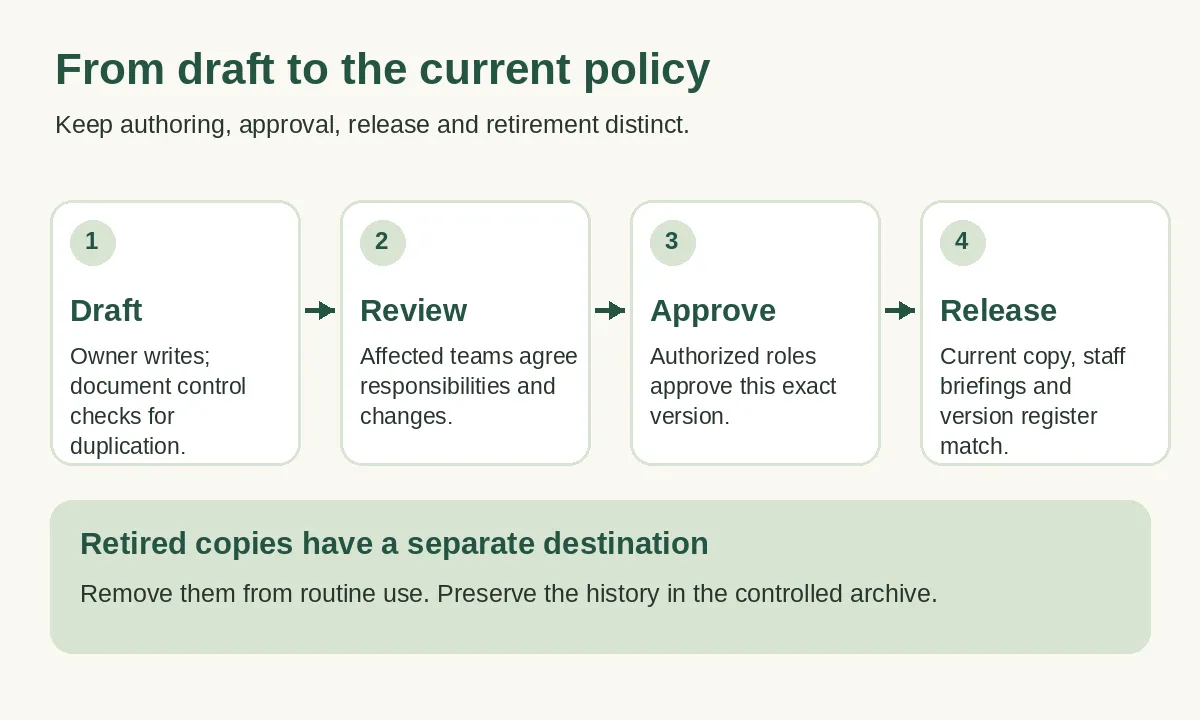
Use numbered steps with an action, responsible role and output. For example, “Document control checks the register for an existing instruction and records whether a new document is needed” is clearer than “Avoid duplication.”
A practical sequence is:
- The requester explains the need, intended users and whether the request is new, a revision, a replacement or a withdrawal.
- Document control checks for existing documents and identifies the owner and approval route.
- The owner drafts the content and attachments using the facility’s format.
- Affected departments and subject-matter reviewers check their responsibilities and return specific proposed changes.
- The owner resolves comments, obtains required concurrence and submits one consolidated final draft.
- Document control checks format, identifiers, attachments and signature fields before sending the exact version for approval.
- The authorized approver records the decision; rejected or deferred requests return to the owner with reasons.
Define how an approved version is frozen for release. If content changes during signature collection, say how the change returns to review and approval rather than leaving different signatories approving different text.
For outside guidance or templates, write an assessment and adoption route. Identify who checks relevance to local services, resources and governing requirements, and who authorizes use. Receiving a document from an outside organization does not make it an approved local instruction.
Separate the approval date from the effective date
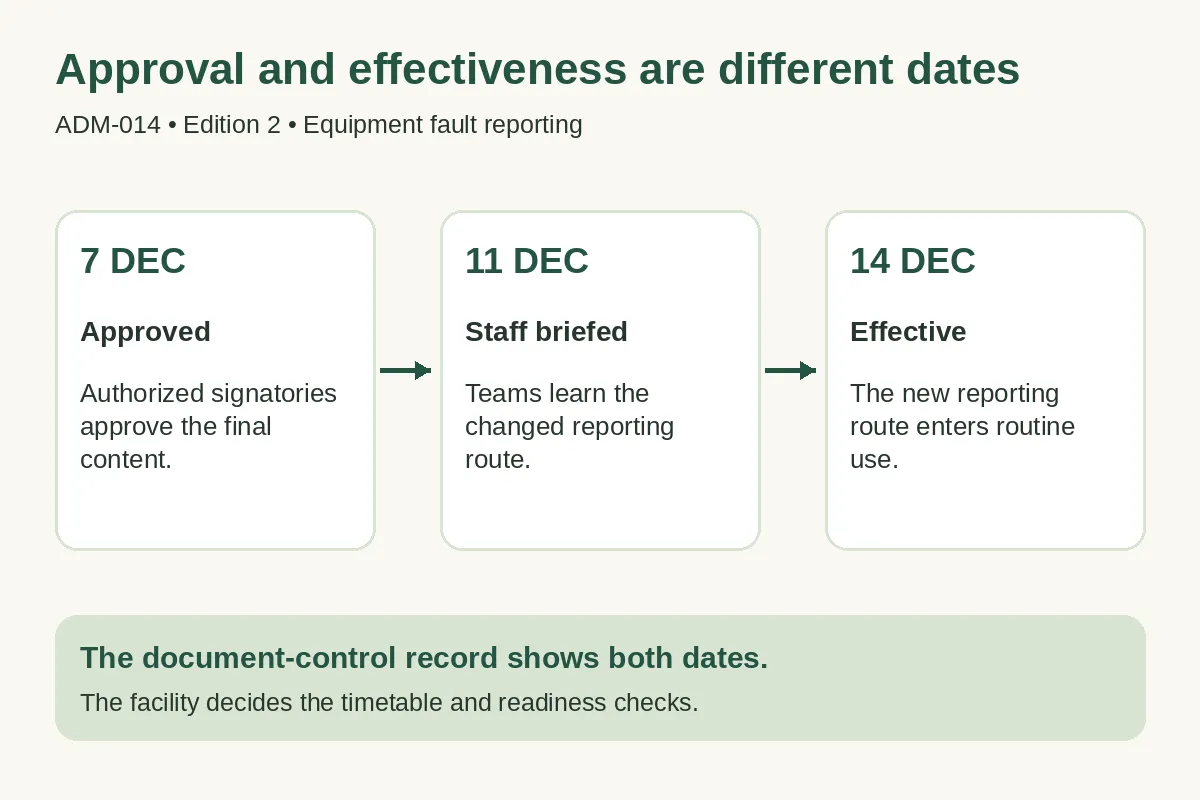
The approval date records authorization of the content. The effective date records when staff should start using it. Those dates may differ when training, equipment, forms or communication must be ready first.
Here is a worked example. A facility revises its equipment fault reporting policy, ADM-014, to edition 2. The final version is approved on 7 December. Department heads brief staff on 11 December, and the new reporting route becomes effective on 14 December. The timeline below shows the three distinct events; the dates are choices for this example, not a required hospital timetable.
Write who confirms readiness and who announces the effective date. Include a route for urgent changes that cannot wait for the routine release cycle, with the appropriate local authorization and staff notification. Do not leave staff guessing whether an approved future version has already replaced the current instruction.
Release the current copy and retrieve the old one
Name the official staff-access location and the people allowed to publish or replace files there. Keep working drafts separate from the current repository. Identify how staff obtain instructions if the normal system is unavailable.
Mercy Hospital’s Document Control Policy, reviewed March 2024, provides a concrete institutional approach: designated controllers, read-only documents on SharePoint, staff communication after ratification and an updated paper set for computer or power failure. Those are its arrangements, not a requirement to buy the same software.
For your facility, record where controlled copies are issued, who keeps them current and what proves replacement is complete. An email saying “new policy attached” does not retrieve the previous file saved on a shared drive or the copy inside a department binder.
In the ADM-014 example, document control updates the staff link to edition 2. The department’s designated person inserts edition 2 in the binder and retrieves edition 1. The archive retains edition 1 with its approval and replacement history, separate from routine staff use. The diagram shows why updating a link and preserving an archive are different tasks.
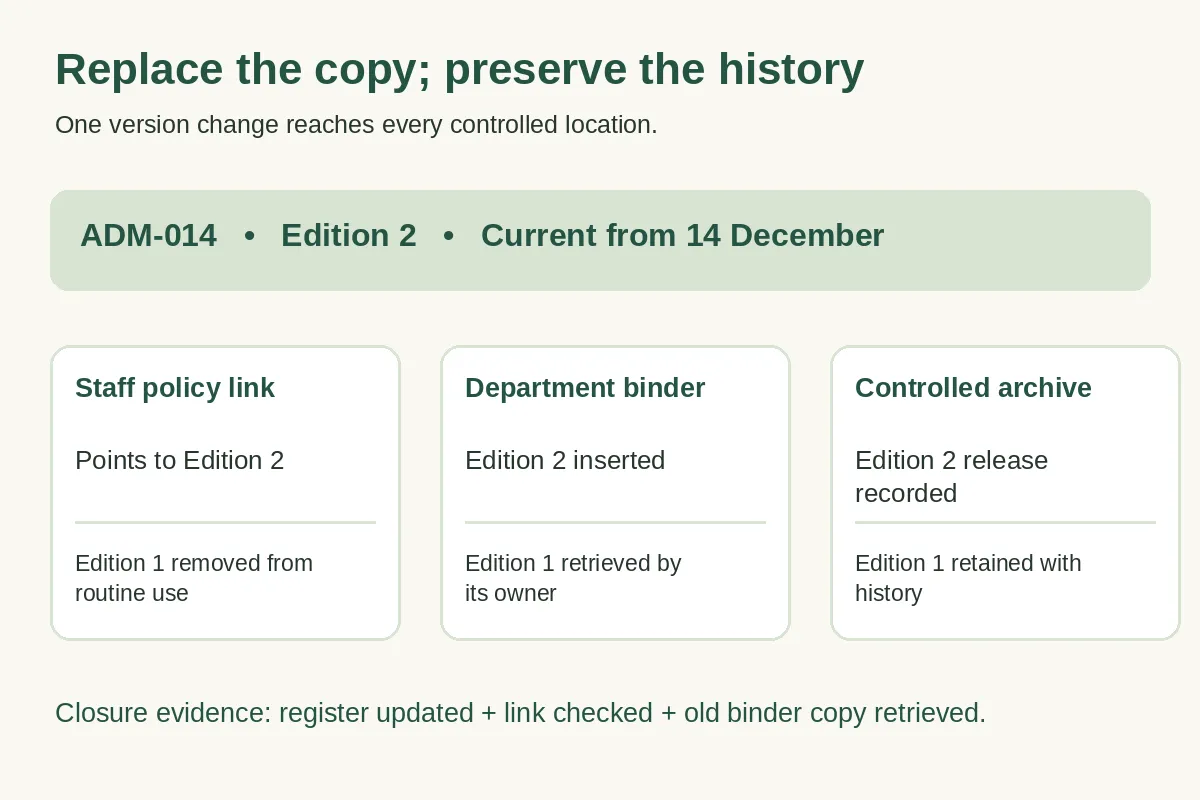
Close the release record only after the register, live link and controlled-copy checks agree. Record staff education against the change that affects their work, rather than treating distribution alone as evidence that they understand it.
Set review triggers and a controlled withdrawal process
Specify a scheduled review interval, who monitors due dates and when the owner starts review. Also require earlier assessment when services, responsibilities, evidence, equipment, medicines or applicable requirements change. Do not copy a period from another hospital as though it applied everywhere.
Make “reviewed, no change” a recorded decision. Identify the reviewer, date, version checked and next review date. For a revision, record what changed and why, including attachments and any implementation consequences.
Withdrawal needs its own route: justify why the document is no longer needed, check that another instruction or requirement is not left uncovered, obtain the designated approval and remove it from current access. Record whether responsibilities transfer to a replacement document.
Keep previous versions and approval history under a locally approved retention schedule. Separate obsolete documents from routine access and define who may retrieve them. The facility’s records and legal requirements determine retention and destruction; the policy should point to that authority rather than guess a universal number of years.
Test the register, forms and procedure together
Ask a document owner, controller and department head to walk through one version change. Can they identify the approval route, complete the application, find the current copy, arrange education, retrieve the old copy and locate the release evidence without asking the author what was intended?
Then test a rejected request, a no-change review and a withdrawal. Check that the workflow diagram and signature table name the same final authority. Check that the stated effective date matches the release notice, and that every attachment belongs to the version staff use.
Have the facility’s governance, clinical, records and privacy leads confirm the local authority, applicable requirements, access and retention arrangements before adoption.
Questions about your policy topic or file access? Email Policy Writer with your care setting, without patient information or confidential records.