
How to write hospital committee terms of reference
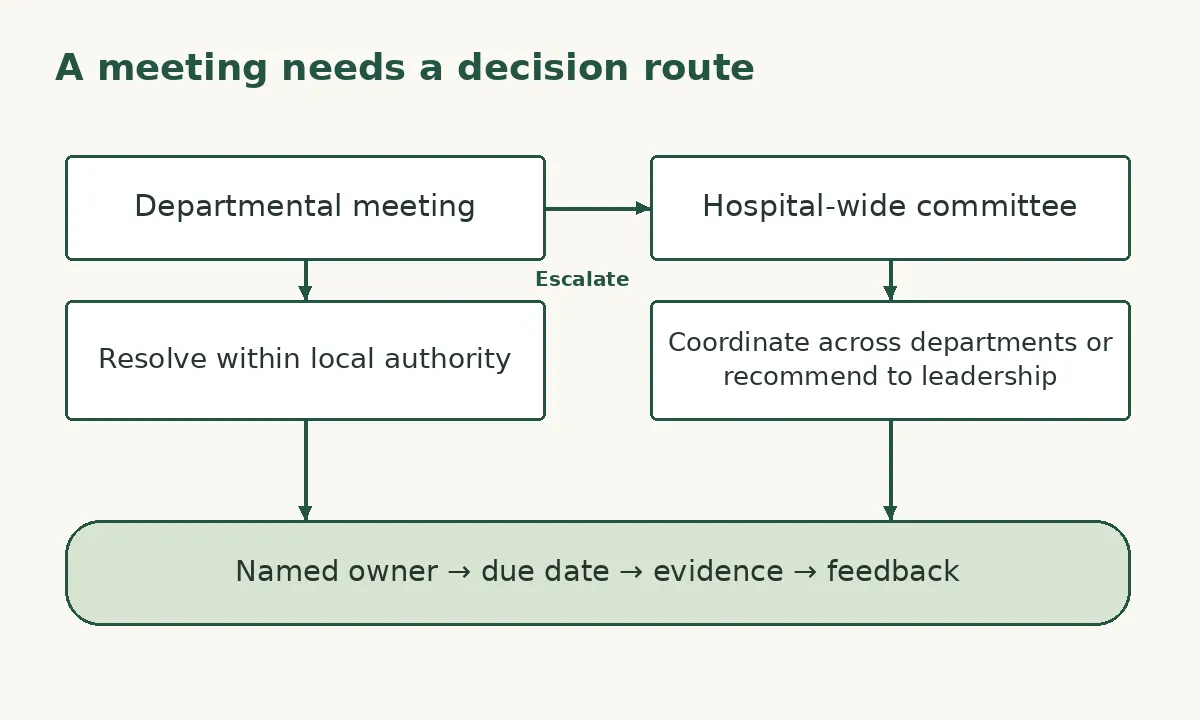
Hospital committee terms of reference should say why the committee exists, what it can decide, who takes part, how meetings run and where recommendations go. A wider committee and departmental meeting policy connects those terms to appointment letters, minutes, action tracking and annual review. Start with the decision route, then write the meeting rules around it.
For a structured starting point alongside this guide, explore our matching Formation and Management of Hospital-wide Committees & Departmental Meetings policy. Use it alongside the guidance below, then review and adapt it locally.
The matching policy
Formation and Management of Hospital-wide Committees & Departmental Meetings
Read the scope, contents and preview to see whether this policy fits your facility.
Explore the policyDefine the purpose and scope before naming members
Terms of reference (TOR) are the written rules that define a committee’s remit, authority, membership and working arrangements. A departmental meeting handles matters within one department; a hospital-wide committee brings together the roles needed to address an issue across services or advise leadership.
Write a purpose that names the work. “Review recurring handover failures and recommend cross-department improvements” gives members a clearer task than “promote quality.” Then list the services, staff groups and issues within scope, together with exclusions that belong elsewhere.
Before establishing a new committee, ask Quality Management or the controlled-document custodian whether an existing committee already covers that work. If it does, identify the referral route rather than creating a second body with the same responsibilities. The decision path below shows where this check belongs.
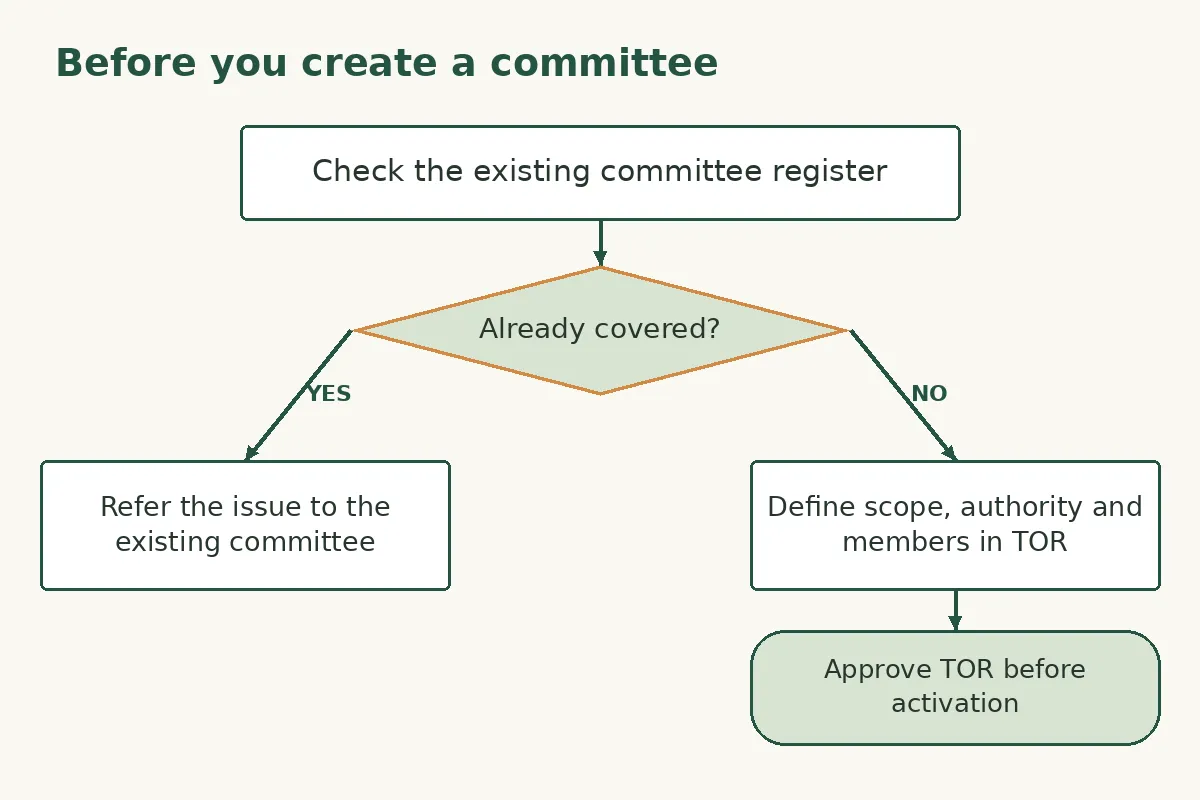
For a new committee, identify its approval authority, allocate a controlled document number and prepare the TOR. Record who approves administrative, clinical and other committee requests. File the approved original and distribute controlled copies before activation; if the request is declined, return the reasons to the requester.
Write hospital committee terms of reference in twelve parts
Use this outline to draft the rules. Each section should answer a decision a chairperson or secretary will face.
| TOR section | What to write |
|---|---|
| Definition | Explain committee-specific terms that members may interpret differently. |
| Purpose | Name the problem or oversight function the committee exists to address. |
| Authority | State who appoints the chairperson and deputy, what the committee may decide, and what needs higher approval. |
| Reporting relationship | Name the receiving committee or executive, and the route for urgent escalation. |
| Responsibilities | List the committee’s functions and the outputs expected from each. |
| Meeting frequency | Set the regular calendar, additional-meeting triggers and who can call them. |
| Membership and quorum | Name member roles, voting eligibility, required representation and the minimum attendance for valid decisions. |
| Minutes | Set the recording format, chair review, confirmation, circulation, storage and access arrangements. |
| Evaluation | Specify how accomplishments, unresolved issues and membership participation are reviewed. |
| Revision | Record changes, their reasons and the approving authority; identify the current version. |
| References | List the local governance documents and applicable standards used to set the rules. |
| Distribution | Identify recipients and the custodian of the signed original. |
Separate decision authority from recommendation authority. A committee allowed to recommend additional staffing has not necessarily been authorized to approve the budget. Make the next approval step explicit in the TOR and the minutes.
Make quorum and conflicts workable
Quorum is the minimum eligible attendance required for a committee to conduct formal business. Write both the number or calculation and any roles that must be present. Also decide how authorized deputies, remote attendance, vacancies and conflicts affect that calculation.
Say a locally approved TOR uses a 70% quorum for ten voting members. Seven eligible members must attend. If one of those seven is excluded from an agenda item because of a conflict, the chair needs a rule for whether the remaining attendance can still make that decision. Define that rule before the meeting, rather than improvising when the item is reached.
Do not copy a quorum percentage as though it were a universal hospital requirement. The University Hospitals of North Midlands Rules of Procedure, July 2025 use different quorum arrangements for different bodies and describe informal continuation without formal decisions when a meeting is inquorate. Those are that organization’s rules; your facility must approve its own.
For conflicts, require the member to declare the interest and record the decision about participation. Specify who chairs an affected item if the chairperson has the conflict. Then record withdrawal, any effect on quorum and the decision route in the minutes.
State whether decisions use consensus or majority voting. If voting is allowed, define eligible voters, how abstentions are handled and what happens with a tie. Guest expertise should not silently become a voting right.
Assign the work before the first invitation
Name the local equivalents of these roles. A small facility may combine some administrative duties, but the duties still need an owner.
- Chairperson: approves the agenda, leads discussion, checks decision authority and reviews the minutes and action plan.
- Members: prepare, attend, contribute within their expertise and report back to their departments. Use appointment letters for regular membership.
- Facilitator: coordinates the calendar, agenda and follow-up of open issues with the chairperson.
- Secretary: issues approved invitations, records minutes and manages their distribution and filing. The facilitator and secretary may be one person where workload and confidentiality allow.
- Committee coordinator: maintains the facility-wide calendar and follows up missing meetings or minute copies.
- Department head: holds departmental meetings and sends appropriate issues to the relevant hospital-wide committee.
- Quality Management and leadership: review reports, receive escalations and act on recommendations within their assigned authority.
For representatives, have the department head nominate someone with the knowledge and authority to participate. Keep regular members and invited guests distinct in the membership register.
Connect departmental agendas to hospital-wide oversight
A departmental template should begin with attendance, apologies and previous open actions. Give recurring topics their own rows so they do not disappear into “any other business.” For medical departments, these may include mortality and significant morbidity review; other recurring headings can cover quality and patient safety, infection prevention and control, and environment of care.
Set meeting frequency according to the work and locally required oversight. Distinguish a department’s general meeting calendar from any separate monthly clinical case-review requirement. A missed general meeting should not erase a required case review.
For each topic, the department should decide whether it can resolve the issue within its authority or needs referral. Cross-department actions, resources beyond delegated authority and unresolved risks need a named receiving body. Urgent safety concerns must follow the facility’s immediate escalation process, without waiting for the next routine meeting.
For mortality and morbidity discussions, write an improvement-focused process: select cases, examine contributing factors, identify preventive actions and decide which findings require wider review. Keep identifiable case material within approved access arrangements rather than copying it into broadly circulated minutes.
Use minutes as an action record
A minutes table needs six connected fields: topic, discussion, recommendation or agreement, responsible party, follow-up date and open or closed status. Add the meeting date, time, venue, chairperson, attendees and recorder above the table.
Use concise discussion summaries. “Staff discussed handover” does not explain the decision. “Two departments use different escalation contacts; the committee agreed to approve one shared contact list” does.
Here is a worked example. On 2 April, a medical department refers recurring omissions in transfer handovers to a hospital-wide quality committee because nursing and medical workflows both need changes. The committee approves a four-week check, names the quality lead as owner and sets 30 April for the report. The action record below keeps the decision separate from the evidence needed to close it.
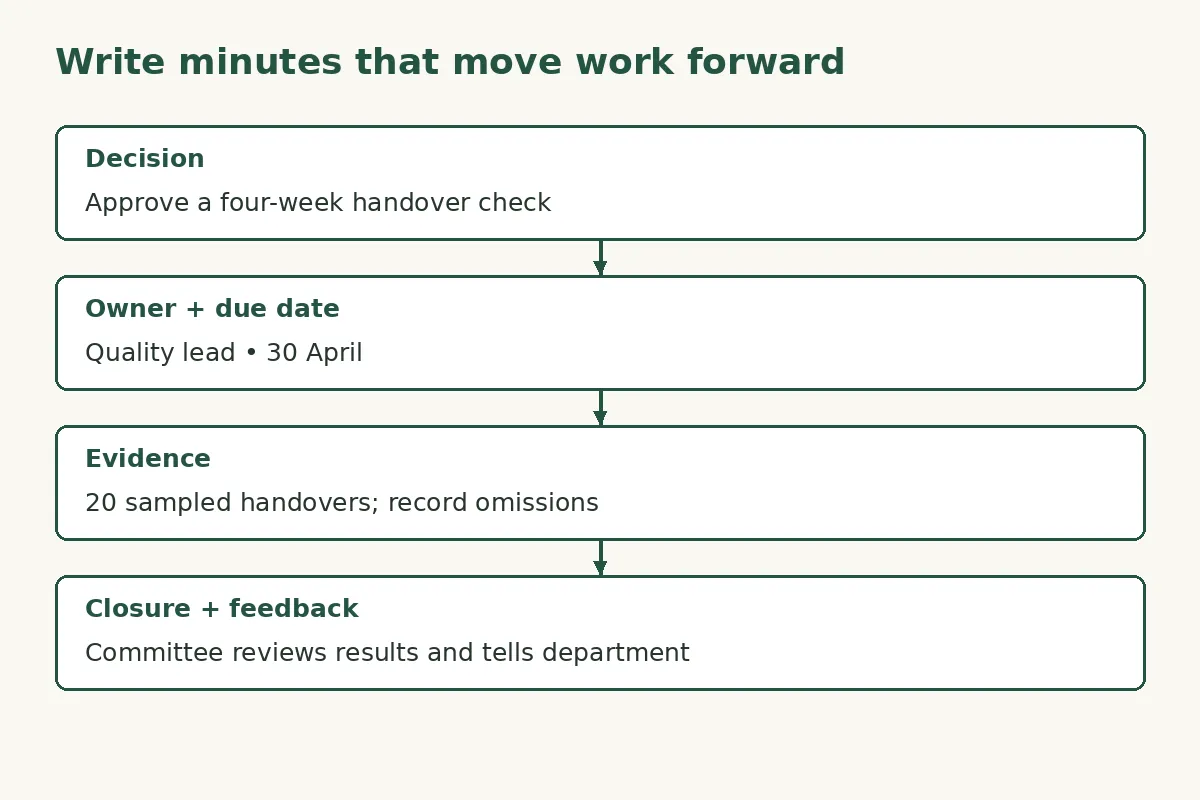
The quality lead samples 20 handovers and records omissions against the locally agreed fields. On 30 April, the committee reviews the findings. If omissions persist, the action stays open with a revised plan; if the agreed closure criteria are met, the committee records the evidence and sends feedback to the referring department. “Training completed” alone would not establish that the handover problem improved.
Keep approval stages distinct. The chair reviews the minutes; members confirm their accuracy through the approved process; any director acknowledgement or action authorization has its own field. A supplementary signature table should say what the signature means, rather than implying every signatory approved every clinical conclusion.
Set the circulation deadline, authorized recipients and controlled storage location. Mark confidential minutes before distribution where the local policy requires it, and limit access according to content. A confidentiality label is not an access control.
Review committee function, not just meeting counts
An annual review should compare the planned and actual meetings, check that the TOR is current, and list accomplishments with responsible people and completion dates. It should also record unresolved issues, owners and target dates.
Review these together:
- Whether minutes are typed, dated, signed or otherwise authenticated under the local process.
- Member attendance and participation, including repeated absences from required roles.
- Liaison needed with other departments or committees.
- The next year’s focus and educational or Quality Management support needs.
- Proposed changes to TOR, activities or duties, with leadership recommendations and signatures.
Meeting totals show whether the committee met. They do not show whether its decisions improved the work. Compare actions with the committee’s responsibilities, and ask whether problems were resolved, referred correctly or repeatedly carried forward without progress.
If the remit overlaps another body, propose a justified change, merger or termination through the authorized leadership route. Preserve responsibility for open actions when the structure changes.
Test the policy before local approval
Walk a chairperson, secretary and department head through one real agenda item. Can they identify the receiving committee, check quorum, manage a conflict, record the decision, assign an owner and return feedback without asking the policy author what was intended?
Check the document-control fields, committee register, meeting calendar, referral route, minute forms and annual review form together. Ask the facility’s governance, clinical and privacy leads to confirm local authority, applicable requirements, access and retention arrangements before adoption.
Questions about your policy topic or file access? Email Policy Writer with your care setting, without patient information or confidential records.