
How to write a patient valuables policy
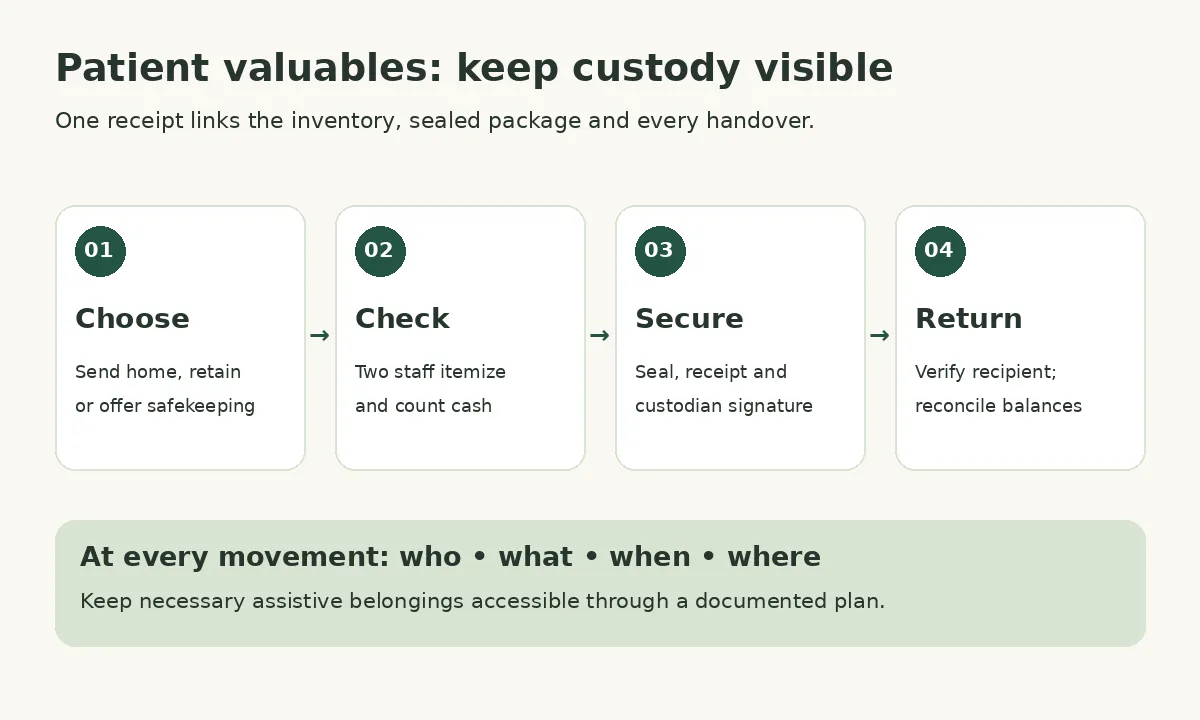
To write a patient valuables policy, define what staff accept for safekeeping, who takes custody and how each item is verified and returned. Build the procedure around one receipt that links the inventory, sealed package, storage location and every handover. Include patient choice, necessary assistive belongings, out-of-hours arrangements and a local review before adoption.
Writing your facility’s procedure? Ask us about the Care of Patient Valuables policy while you work through the guidance below.
Policy enquiry
Care of Patient Valuables
Ask us about this policy and the care setting you are writing for. The matching file is not publicly released.
Enquire about this policyWhat should a patient valuables policy cover?
A patient valuables policy describes how a facility records, safeguards, transfers and returns belongings that matter to a patient. Money, jewellery, phones, wallets and identity documents are common examples. Let patients identify other items they consider valuable rather than relying only on a fixed list.
Start with three possible destinations:
- Sent home: unnecessary items physically handed to a verified, authorized recipient.
- Retained by the patient: items the patient chooses to keep, with an agreed storage arrangement where possible.
- Accepted for safekeeping: items placed in the facility’s approved custody system.
Record the destination for each item. A signature beside an inventory does not explain whether a phone went home, stayed at the bedside or entered secure storage.
Keep clinically necessary belongings in a separate access plan. Glasses, hearing aids, dentures, mobility aids and communication devices may be needed during care. Specify their location, access arrangements and the responsible role; do not automatically lock them away with jewellery.
Give each custody decision a responsible role
Write roles rather than staff names, then fill in your facility’s contacts and storage locations. A small facility can combine roles, but it still needs a second person to independently check the inventory and cash.
| Role | What the procedure must assign |
|---|---|
| Receiving staff | Explain options, assess participation and start the receipt |
| Counting and checking staff | Itemize property, independently verify quantities and count cash |
| Designated custodian | Accept signed handovers, control storage and log access |
| After-hours deputy | Use approved interim storage and transfer custody to the primary custodian |
| Releasing staff and checker | Verify the recipient and reconcile returned and remaining balances |
| Duty manager or incident lead | Resolve discrepancies, protect records and coordinate investigation |
Avoid “staff will keep valuables safe” as a procedure. Name who receives a package, what they check and when their signature confirms acceptance.
Design the receipt before writing the handover steps
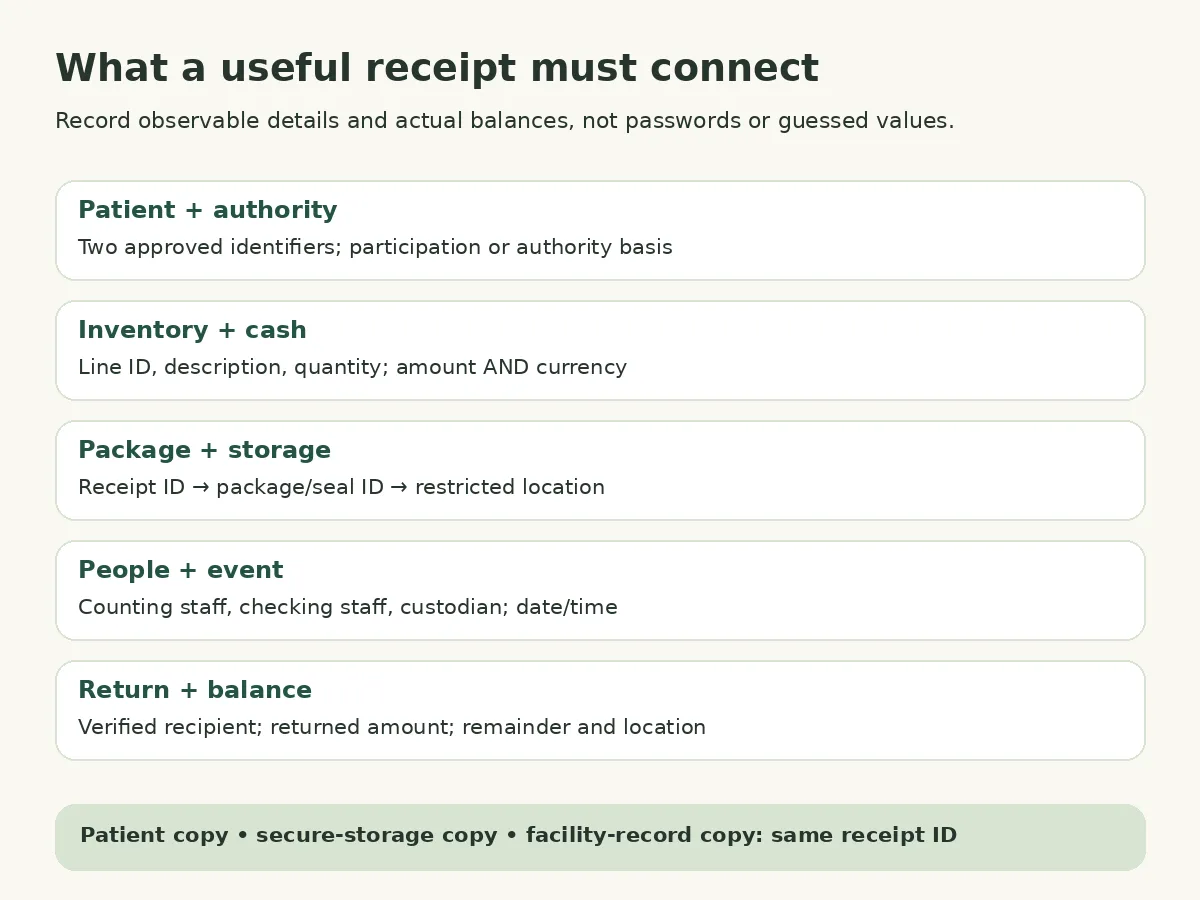
The receipt should make the process possible without relying on memory. Give it a unique identifier and put that identifier on every inventory, movement and return sheet. Link each sealed package to the receipt with a package or seal ID.
The diagram below shows the five connections a useful receipt must preserve.
Include these fields:
- Patient identifiers, date/time and participation or representative authority.
- Item line number, type, observable description, condition and quantity.
- Cash amount and currency, with denomination counts or a linked counting sheet where needed.
- Names, roles and signatures of the counting staff, independent checker and patient or authorized representative.
- Package/seal IDs, receiving custodian, storage reference and acceptance time.
- Transfer details, recipient verification, returned quantities and remaining balances.
- Refusal or retention choices and actual handover to an authorized representative.
Describe what staff can see. “One yellow-metal ring with a clear stone” is more defensible than “one gold diamond ring” unless authenticity is established through an approved process.
Count cash privately with two staff. “120” is incomplete: record “120 USD” or the actual currency involved, and keep different currencies separate. Set your own authorized cash limits and escalation route; do not copy another facility’s limit or improvise a bank deposit.
Do not put patient PINs, passwords, safe codes or full payment-card numbers on the receipt. Copying more sensitive information creates another security problem without improving custody.
Produce patient/representative, secure-storage and facility-record copies with the same receipt ID. State how event updates reach all controlled copies. If the patient cannot receive a copy, record where it is held securely and how it will be provided later.
Write a custody chain that works after hours
A chain of custody is the recorded sequence of people who accept responsibility for identified property. Each event needs the items or package IDs, date/time, sending and receiving people, location and any exception.
Draft the sequence in order:
- Two staff check the listed items and cash before sealing.
- Record package/seal IDs and obtain acknowledgements where possible.
- The receiving custodian checks identifiers, record completeness and seal integrity with the handing-over staff.
- Both record the handover and the approved storage reference.
- Any opening records its reason, witnessed contents check and new seal linked to the old one.
Test the same sequence outside normal office hours. Specify the deputy, interim restricted storage and on-call retrieval route. “Leave the envelope for the custodian tomorrow” leaves a gap unless someone has accepted responsibility and secured it now.
Control keys and codes through authorized roles and access logs. For a patient-operated approved safe, explain key issue/return and the local override process without collecting the patient’s PIN.
A move between care units does not always mean property moves. If the valuables remain in central storage, update the patient’s unit/contact. If the package moves, obtain a signed physical handover with its new location.
Make partial return a separate reconciliation event
A partial return changes the inventory balance; it does not close the whole receipt. Record opening quantity or amount, what leaves custody and what remains, by item line and currency.
For example, receipt V-104 holds one ring, one phone and 120 USD. The patient requests the phone and 20 USD. Two staff check the return with the patient, leaving one ring and 100 USD in storage, as shown below.
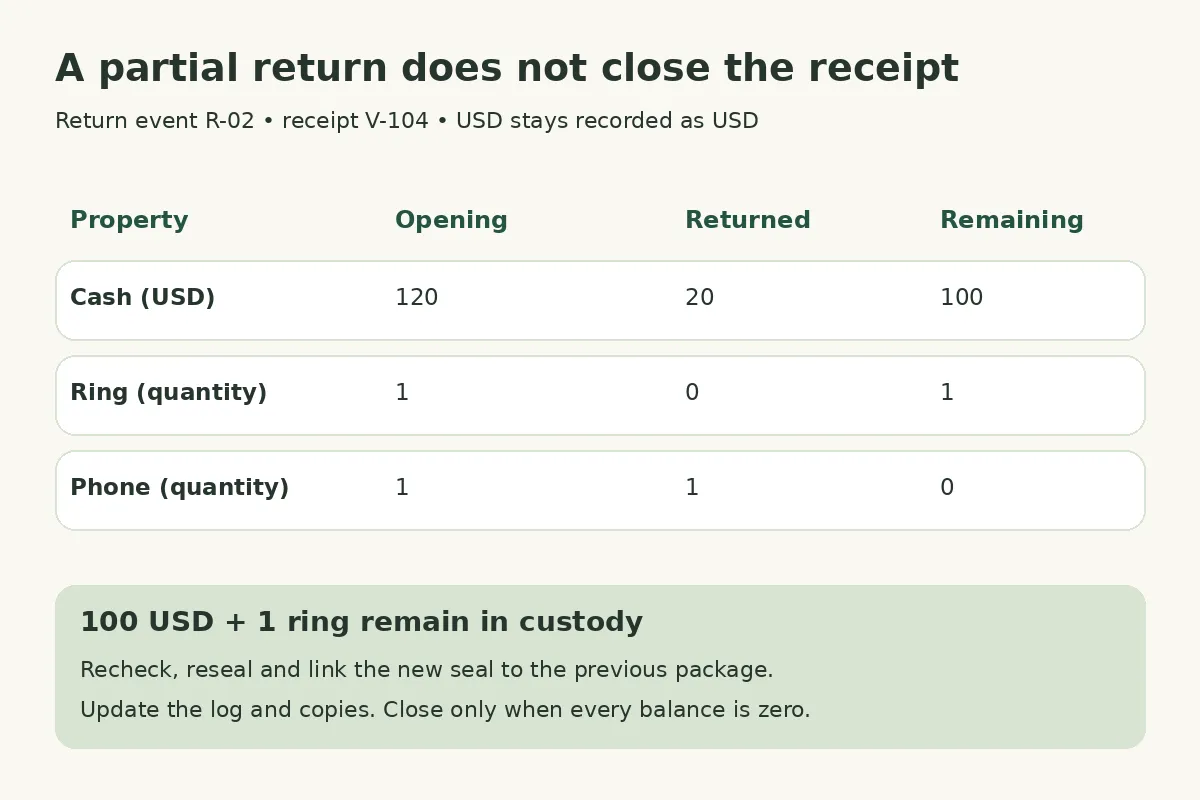
If the retained package is opened, recheck and reseal it. Record the new seal ID, remaining storage location and links to the earlier package. Update the custody log and controlled copies. Mark “all returned” only when every balance is zero.
For release to someone other than the patient, verify both identity and authority for those items. A family relationship or possession of the receipt alone is not enough. Record the verification method and authority reference using only the personal information your approved process needs.
Document informed choice without a blanket waiver
Explain the available storage options and retrieval arrangements, then record what the patient chooses. If safekeeping is declined, identify the retained items and any alternative arrangement. If items go home, document who actually received them and what was handed over.
An acknowledgement can say: “I choose the recorded arrangement after discussion. This records my choice and does not remove statutory rights or excuse negligent handling.”
If the patient cannot participate or sign, record the reason, witnesses and lawful decision basis. Support communication and follow the applicable capacity, consent and representation process. Do not infer incapacity solely from age, and do not let paperwork delay urgent care.
Add a response for broken seals, missing items and death
A discrepancy procedure should tell staff to stop the affected release or transfer, protect the remaining property, preserve the receipt and seals, and notify the custodian or duty manager. Document a witnessed recheck and correction trail rather than silently editing the original inventory.
Link loss or damage to the facility’s incident process. Our guide to writing a healthcare incident reporting policy explains immediate response, reporting and follow-up. Record factual communication with the patient or authorized representative and the investigation outcome.
For deceased-patient or unclaimed property, keep secure custody while the designated lead checks authority, notices, records and permitted disposition. Do not invent a disposal deadline or assume next of kin can receive estate property. Record contact attempts, disputed claims and the authority for the eventual handover or disposition.
Review local rules and test the draft before adoption
Have the facility review custody, capacity/consent/representation, privacy and retention, liability, and deceased-patient/unclaimed-property requirements before approving the policy. Country-neutral wording does not guarantee legal compliance everywhere.
Published institutional procedures can help you compare practical controls. NHS Western Isles’ patient valuables procedure describes sealed packages and receipt copies; Royal Wolverhampton’s patients’ property policy addresses controlled property records. These are institution-specific references, not universal rules to import wholesale.
Run a tabletop test with staff: an after-hours deposit, a patient unable to participate, necessary hearing-aid access, an inter-unit transfer, a partial cash return and a disputed recipient. Can they identify the custodian, storage location, required checks and remaining balance without guessing? Fix those gaps before approval.
Questions about your policy topic or file access? Email Policy Writer with your care setting, without patient information or confidential records.