
How to write a healthcare incident reporting policy
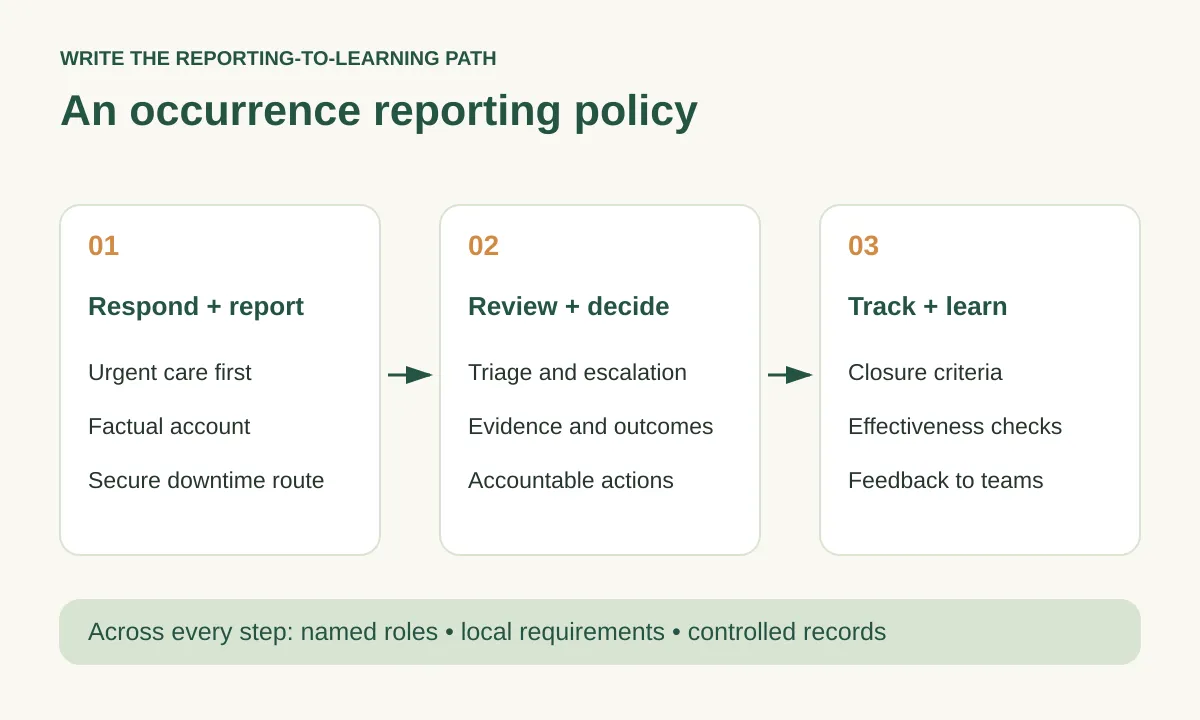
To write a healthcare incident reporting policy, define what staff must report, who responds and reviews, and how each case moves from immediate safety action to learning. Specify a secure reporting route, factual documentation, escalation criteria, harm assessment and accountable follow-up. Include a downtime route and locally approved notification requirements so urgent care and required reporting never wait for a completed form.
An occurrence reporting policy covers incidents, near misses and unsafe conditions. An Electronic Occurrence Variance Report (e-OVR) is the electronic case record used to capture the event, response, investigation and follow-up. The policy explains how people use that record; the form alone cannot assign responsibility or decide when a case is ready to close.
1. Define the purpose and scope before writing steps
Start with a purpose staff can act on: protect people, capture safety concerns, understand contributing factors and reduce recurrence. Include patients, staff, visitors and contractors, along with property, information and service disruptions under the facility's responsibility.
Define these terms near the start:
- Unsafe condition: a circumstance capable of causing harm before an incident occurs.
- Near miss: an incident intercepted before it reaches the person or creates the intended exposure.
- No-harm incident: an incident that reaches a person but causes no discernible harm.
- Adverse event: an incident associated with harm.
Write a scope clause such as: “All personnel report incidents, near misses and unsafe conditions discovered in facility services, including contracted activities under facility responsibility. Report when harm is uncertain or another department is involved.”
Decide how complaints connect to reporting. A complaint describing a safety incident needs a linked incident review; a service-only complaint can remain in the complaints process. Avoid making staff choose one process when both apply.
2. Give every decision an accountable role and an alternate
Use role titles in the procedure and keep current names and contact details in a controlled contact list. Smaller facilities can combine roles, but the policy still needs a route for conflicts of interest and out-of-hours cover.
| Role | What the policy assigns |
|---|---|
| Discovering person / reporter | Obtain help, control hazards within their competence, report facts and retain the case identifier. |
| Treating clinician | Assess and treat the affected person, provide outcome evidence, and document care and relevant communication. |
| Supervisor / on-call manager | Check immediate controls, arrange help and escalate risks beyond the service's authority. |
| Quality and Risk Lead | Triage cases, assign investigators, validate classification, review closure and monitor actions and feedback. |
| Investigation lead | Build the chronology, examine contributing factors and propose an evidence-based action plan. |
| Designated reporting lead and alternate | Assess local external-notification triggers, coordinate submissions and record deadlines and follow-up. |
| Service director / executive | Authorize resources and oversee serious events or unresolved high-risk actions. |
Name the reporting system's access owner and the record custodian too. Reports involving a supervisor should be able to go directly to Quality and Risk or the facility executive rather than back to that supervisor.
3. Write response before reporting in the procedure
The first instruction should be to obtain urgent care, activate emergency help when indicated and protect others. Staff must not wait for permission, a manager's signature or an available electronic system before responding to danger.
Then describe the reporting sequence:
- Obtain clinical or specialist help and control continuing exposure within the person's competence.
- Preserve relevant equipment, packaging and records safely. Care and infection control take priority over evidence preservation.
- Submit the initial factual report through the approved route, even if some facts remain unknown.
- Notify the supervisor and Quality and Risk; use the on-call route when necessary.
- Confirm receipt and a case identifier. If routing fails, contact the receiving role through the secure alternative.
The workflow below shows a separate external-reporting route. Required notifications may need to happen while care, triage and investigation are still underway.
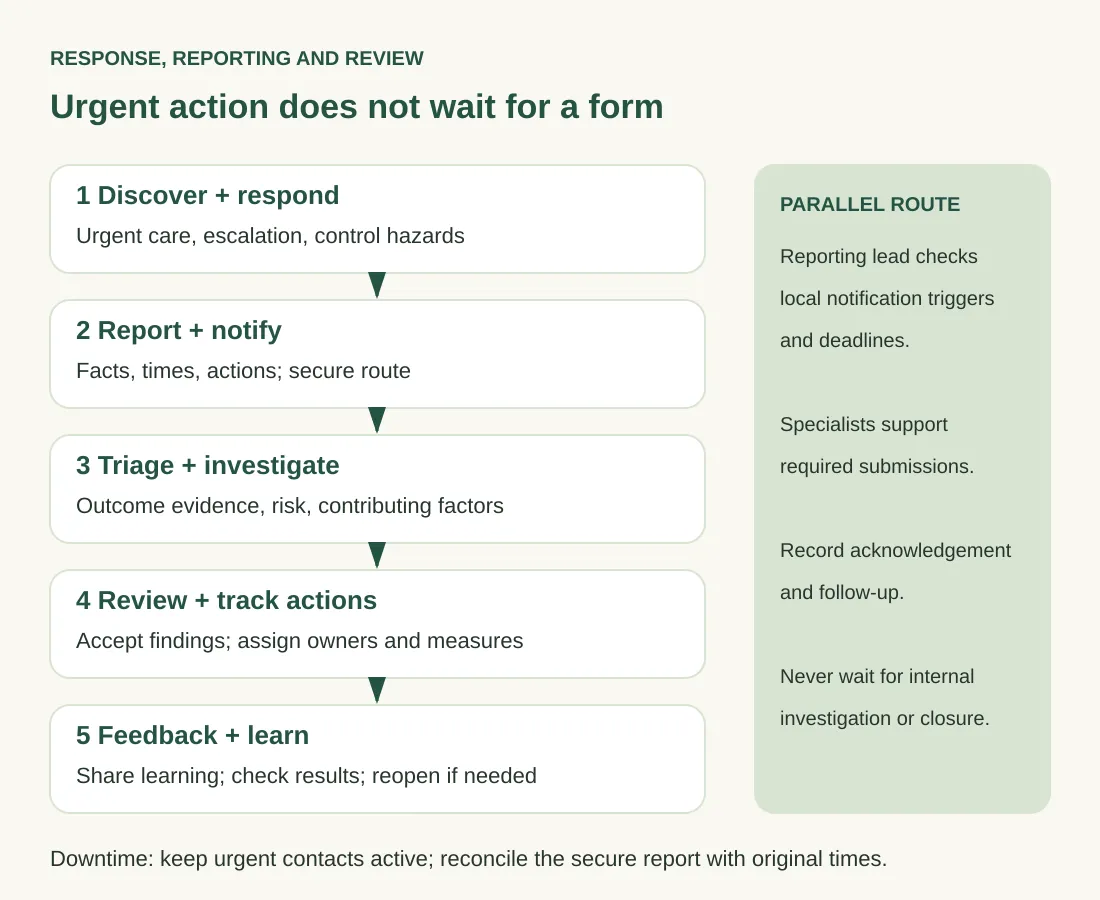
For downtime, specify a secure temporary record, its receiving role and a temporary identifier. After restoration, assign someone to enter it into the system, preserve the original event, discovery and reporting times, check for duplicates and confirm routing. Personal messaging is not a substitute for an approved secure channel.
4. Show staff what factual documentation looks like
The initial report needs enough information to start a review, not a finished explanation of why the event happened. Require:
- Event time, or “unknown,” and discovery and reporting times.
- Location, service and affected person or asset using approved identifiers.
- A sequence of observations, distinguishing what the reporter saw from what others told them.
- Immediate care, hazard controls and notification times.
- Known outcome, uncertainty and any continuing risk.
- Relevant record, attachment or specialty-report identifiers.
Consider a medicine-selection near miss in a small outpatient service. At 09:10, a nurse checking a prepared medicine against the order finds a different strength. The medicine has not been administered. The nurse pauses administration, separates the item under the approved procedure and contacts the responsible clinician and pharmacy lead.
A weak report says: “Pharmacy was careless and nearly harmed the patient.” It assigns blame and leaves out the sequence.
A useful account says: “At 09:10, during the pre-administration check in Treatment Room 2, I observed that the prepared item's labelled strength differed from the active order. The item had not been administered. I paused administration, secured the item under the approved procedure and notified the responsible clinician and pharmacy lead at 09:12. The pharmacy lead advised that they would review the preparation record.”
Enter required identifiers and medicine details in the secure fields. Attribute later information to its source. Do not delay the initial report to complete a specialty form; link that record when available.
State where documentation belongs. Patient assessment, treatment, monitoring and care decisions remain in the clinical record. Investigation material belongs in the authorized incident repository. Corrections and late entries follow the facility's record-correction procedure; nobody backdates or deletes an original entry to make the account fit.
5. Separate event category, actual harm and risk priority
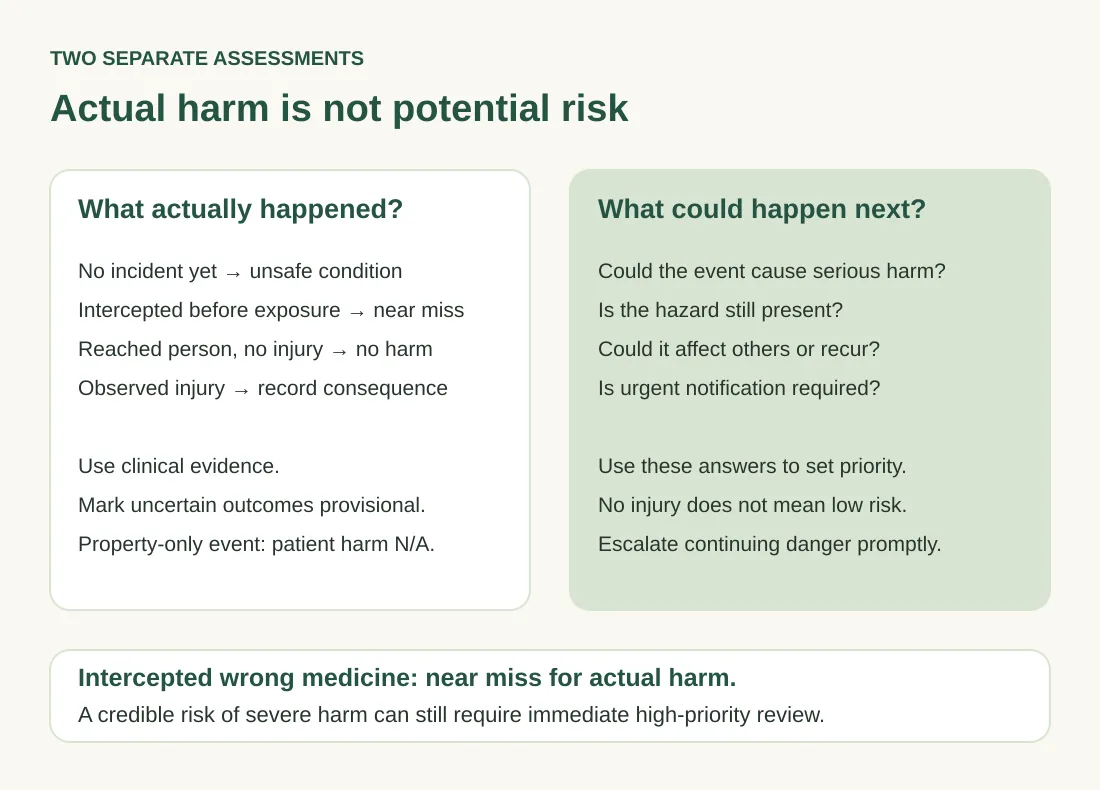
An event category describes the type of incident, such as medication, fall, equipment or privacy. Actual harm describes the observed consequence. Risk priority determines how urgently the facility must respond and investigate, considering credible potential harm and continuing exposure as well as actual outcomes.
In the medicine case, interception before administration supports a near-miss classification. It does not establish low risk: the wrong strength could still have serious consequences if the underlying selection problem recurs.
Use the two assessments below when drafting your classification instructions.
Choose one approved harm scheme and define its terms consistently. If you use letter codes, print the definitions beside them and test borderline cases. A facility-defined scheme is not automatically equivalent to an external taxonomy.
| Decision to test | What the instruction should clarify |
|---|---|
| Exposure occurred, but extra monitoring found no injury | Monitoring to confirm no harm is distinct from treatment of an injury. |
| Temporary harm caused an inpatient admission | Record the harm-related admission; do not infer permanent harm from length of stay. |
| Life-sustaining intervention was needed | Route urgently and document supporting clinical evidence. |
| Outcome is still uncertain | Mark the assessment provisional, name its reviewer and set a reassessment point. |
| Only property or information was affected | Use patient harm “not applicable”; assess operational impact and any personal harm separately. |
For several affected people, retain each person's outcome rather than hiding differences inside one case code. Suspected serious harm or a continuing danger needs immediate escalation before final classification. The facility's serious-event criteria and local notification triggers should be checked separately from the harm code.
6. Set escalation routes and distinguish targets from deadlines
Replace “inform management as appropriate” with a trigger, recipient, route and alternate. Include serious suspected harm, ongoing danger, safeguarding concerns and possible mandatory-reporting events. Identify specialist routes for medicines, devices, infection, occupational exposure, privacy and other relevant concerns.
Keep two timetables:
- Internal operating targets: when staff submit, triage, assign, review and provide feedback.
- External requirements: legally or otherwise required notifications, their recipients, deadlines and starting points.
A facility might propose initial reporting before the end of the shift and within 24 hours of discovery, with urgent escalation immediately. That is an internal target for local approval, not a universal legal deadline. Set risk-based investigation dates and require a reason, interim control, revised date and named owner for extensions.
Create a controlled local reporting register with the event trigger, recipient, time limit, clock-starting point, channel, required information, responsible lead, alternate and follow-up duties. Reporting-lead coordination must not remove any individual's applicable reporting duty. Internal investigation or closure must never postpone a required notification.
7. Write an investigation method that produces usable actions
Assign one accountable investigator with relevant competence and suitable independence. Set the scope and due date, involve necessary specialists and link parallel reviews through the same case identifier.
Require a chronology supported by records, interviews and equipment or system evidence. Separate established facts from uncertainties. Examine workflow, workload, handover, environment, equipment, training and supervision rather than stopping at “staff should be more careful.” Match investigation depth to the event's risk and the facility's serious-event process.
For the medicine case, review how the strength was selected, prepared, labelled and checked. If evidence identifies confusing storage and labelling as contributing factors, “remind staff” alone leaves those conditions unchanged. An action could separate easily confused items and change the selection cue, with pharmacy oversight.
Write each action as a small, testable commitment:
| Action field | Worked case entry |
|---|---|
| Change | Separate easily confused strengths and revise the storage label after pharmacy review. |
| Accountable owner | Pharmacy lead. |
| Due date / interim control | Set an approved date; maintain the interim check under the local medicine procedure until the change is verified. |
| Completion evidence | Approved layout and label change recorded in the secure improvement register. |
| Effectiveness check | Review 20 selection checks across two weeks for correct-strength selection; record findings and investigate any mismatch. |
The sample size and period here are planning choices for this worked case. Select measures proportionate to your own risk and activity; zero mismatches in a small check does not prove the risk has disappeared.
8. Define closure, feedback and continuing action tracking
A submitted form is not a closed review. State who can approve closure and require adequate findings, supported classification, controlled immediate risks and documented external-notification status.
Actions should either be completed with evidence or transferred to a linked improvement register with an accepted owner, due date and monitoring plan. Unresolved high-risk actions require executive oversight and continuing escalation. Closing the incident review must not make its actions disappear.
Require receipt acknowledgement, proportionate status updates and feedback to the reporter and relevant teams. In the medicine case, feedback can explain the confirmed contributing factors, storage change and planned effectiveness check without sharing unnecessary personal details. Give reporters a route to request clarification, and allow reopening when new evidence or recurrence changes the assessment.
Track themes, repeat events, overdue actions and effectiveness results. The World Health Organization's incident reporting and learning guidance, including its 2020 technical report, connects reporting with structured learning. A report count alone cannot show how safe a service is; changes in willingness to report can affect the count.
9. Test the policy against local requirements before approval
Before adopting a healthcare incident reporting policy, walk one urgent event, one near miss and one downtime case through the full procedure. Confirm that each step has a role, route and record, including an out-of-hours alternate.
Complete the document-control fields: owner, version, approver, effective date, review date and controlled location. Have the relevant clinical, quality, privacy and reporting leads check:
- Local notification triggers, recipients and deadlines.
- Privacy, access permissions, retention, preservation and secure disposal.
- Patient or representative communication, consent and safeguarding requirements.
- Fair review, good-faith reporting and protection from retaliation, without promising blanket immunity or legal privilege.
- Connections to emergency, medicine, device, infection, complaints and workforce procedures.
- Tested system routing, downtime reconciliation and staff orientation.
Local adaptation and formal facility approval determine how the policy can be used in your setting; a template does not guarantee a regulatory outcome.
Start with the e-OVR policy
Policy Writer's published Electronic Occurrence Variance Report (e-OVR) policy provides reporting and review procedures, event categories, a facility-defined harm scheme, a workflow, and initial/downtime and investigation/action records in DOCX, PDF and Markdown. Accounts with a complimentary library grant can view and download the files from their dashboard; paid checkout is unavailable. Ask about the policy or file access at policy-writer@brainer.one, sharing your policy topic and care setting without patient information or confidential incident records.