
How to write a near miss reporting procedure
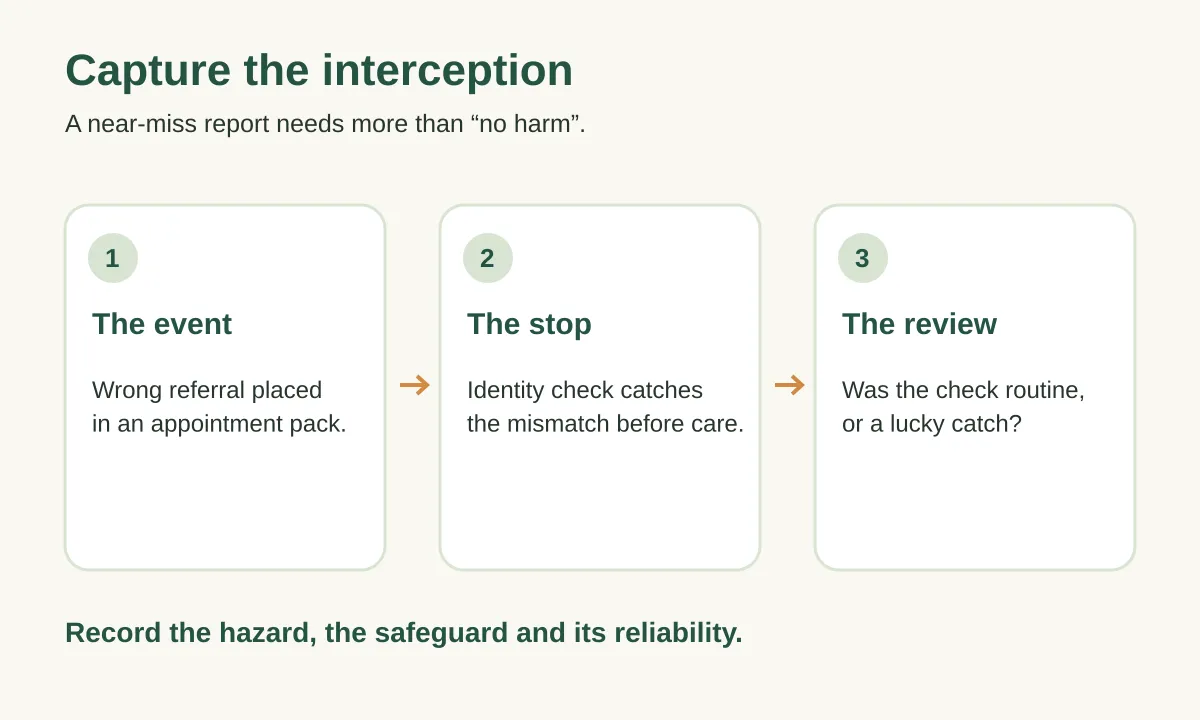
To write a near miss reporting procedure in healthcare, tell staff to record what almost happened, what stopped the event from reaching the patient, and what risk remains. Assign a reviewer to examine whether the safeguard was reliable and whether the same failure could recur elsewhere. Use the facility's incident reporting route so near misses receive follow-up rather than disappearing into a separate, unmonitored log.
Define a near miss by whether the event reached the patient
A patient-safety near miss is an incident that did not reach the patient. If the incident reached the patient but caused no discernible harm, it is a no-harm incident instead. These definitions come from the World Health Organization's patient safety definitions, published in its 2011 curriculum guide.
Don't make staff prove the final classification before submitting a report. Give them an “outcome uncertain” option and assign the reviewer to clarify it. A patient-safety near miss can also involve a separate information-security or operational incident that already occurred; assess those consequences on their own terms.
For the full responsibilities, escalation and document-control structure, use the healthcare incident reporting policy writing guide. The instructions below fit within that policy's reporting and review sections.
Write the near miss reporting procedure around the interception
Start with an instruction staff can use:
After addressing immediate danger, submit a report through the approved incident reporting route. Describe the event sequence, the point at which it was intercepted, the person or safeguard that detected it, and any continuing exposure. Report even when the cause or outcome is uncertain; the designated reviewer will confirm the classification and follow-up.
Then name the receiving role, secure reporting channel, out-of-hours alternate and internal submission target. Set the target through local approval rather than copying another facility's deadline. Reporting must not delay urgent care or any applicable external notification.
Add three prompts to the initial form:
| Prompt | What the reporter should capture |
|---|---|
| What almost happened? | The incorrect item, information or action, its intended destination, and how far it progressed. |
| What stopped it? | The exact check, alert, observation or intervention, and when it occurred. |
| What remains exposed? | Other items, appointments or services that may share the same problem, including uncertainty. |
Use approved identifiers in secure fields. Let the reporter describe what they observed without requiring them to diagnose the process failure.
Use a worked report that preserves the sequence
Say a small outpatient service finds another patient's referral in an appointment pack during the required identity check, before the consultation starts. The referral has not been used to make a care decision.
A useful initial account could read:
At 08:40, while checking the referral against the appointment record before consultation, I observed that the patient identifiers did not match. The consultation had not started and the referral had not been used for care. I separated the incorrect referral under the local records procedure and notified the clinic coordinator at 08:43. The coordinator arranged verification of the correct pack before use. I do not know whether other packs contain mismatched referrals.
The account identifies the interception without guessing who assembled the pack or why the mismatch occurred. The reviewer still needs to check the clinical sequence and any privacy implications; “no care decision made” does not settle whether information was handled appropriately.
Ask whether the safeguard was routine or a lucky catch
The review should distinguish a dependable control from a fortunate interruption. Write these questions into the review instructions:
- Was the check required at that point, and did staff follow it as designed?
- Would the check still work during a busy session, with a temporary worker or after a handover?
- Did the system make a mismatch visible, or did someone recognize a familiar name by chance?
- Could the same failure bypass the check in another service or workflow?
In the referral case, a documented identity check may have worked correctly. That is useful evidence about the safeguard, but it doesn't explain why the wrong referral entered the pack. Review the assembly process as well as the final check. Avoid recording “staff vigilance prevented harm” as the entire finding.
Separate correcting the case from preventing recurrence
Replacing the referral resolves the immediate pack problem. A process action needs evidence about how the mismatch arose and a way to check that the change works. The distinction below helps reviewers avoid closing the learning task when the individual correction is finished.
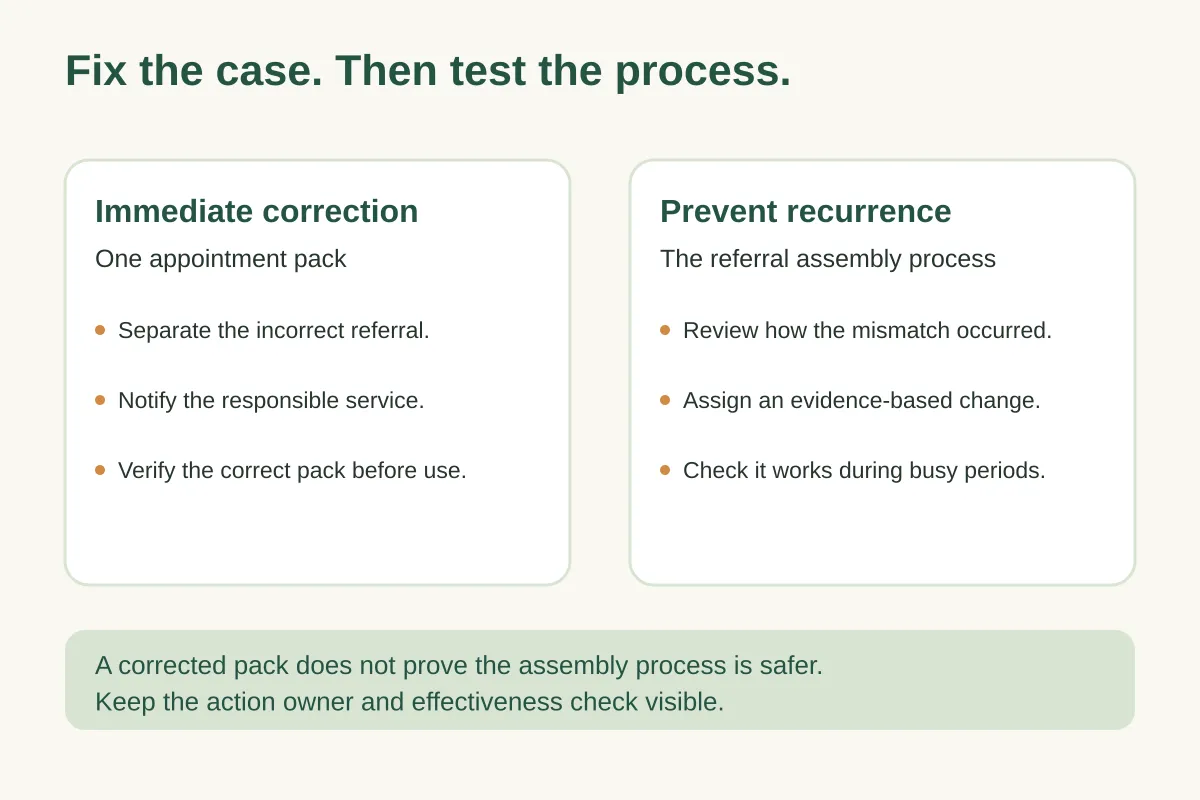
If the review finds that several patients' papers were assembled together and became mixed, a proposed change might be to assemble one patient's pack at a time and verify identifiers before release. Assign the clinic coordinator to test the revised method during ordinary and busy sessions, record mismatches and interruptions, and report the findings to the quality lead. Confirm that the change fits the service before adopting it.
Keep related reports individually traceable, but link repeated referral mix-ups to the same improvement action. Specify a reassessment trigger: another mismatch after the change, a missed check, or evidence that another service uses the same assembly method.
Give reporters feedback about the change
Require feedback that answers three questions: what was found, what changed, and how the facility will check the result. In the referral case, feedback can explain the assembly change and planned observation without circulating patient details.
AHRQ's PSNet primer on reporting patient safety events, reviewed in 2025, identifies missing feedback as a barrier to reporting and emphasizes analysis and process improvement over collecting reports alone. It also explains why voluntary reports capture only part of the safety picture.
Don't use a falling near-miss count as proof that the process is safer. Review repeat patterns, whether safeguards were followed and whether assigned changes worked alongside the reports. Staff may submit more reports because they have become more willing to report.
Fit the procedure into your facility's policy
Before adoption, ask the facility's quality, clinical and privacy leads to confirm the classification rules, notification duties, secure record handling and local approval requirements. Test the wording with a routine interception and a catch that happened only by chance.
Policy Writer's published Electronic Occurrence Variance Report (e-OVR) policy includes initial reporting and investigation/action records in DOCX, PDF and Markdown for local adaptation. Accounts with a complimentary library grant can download the files; paid checkout is unavailable. Ask about the policy or file access at policy-writer@brainer.one, sharing only your general policy topic and care setting, without confidential incident records.